Search the Community
Showing results for tags 'food'.
-
Moniack Mead c.1998 Vintage D.D.Teoli Jr. A.C (5)1920×1601 453 KB Moniack Mead c.1998 Vintage D.D.Teoli Jr. A.C (4)1920×1362 640 KB Moniack Mead c.1998 Vintage D.D.Teoli Jr. A.C (3)1356×2623 643 KB Moniack Mead c.1998 Vintage D.D.Teoli Jr. A.C (2)1321×2623 556 KB image1920×1214 324 KB This bottle is a c.1998 vintage. The original plastic capped cork closure rotted away, and I replaced it with a silicone cork. This is the original color of the mead. I have not been following mead for some years, but I was into mead pretty big in the 1990s. If you don’t know what mead is, it is an ancient, fermented wine or alcoholic drink made from honey. Moniack Mead was made from caramelized Heather honey in Inverness, Scotland. It is a dessert mead on the sweet side. If you like ice wine or German Trockenbeerenauslese, you probably would have liked this. You can skip the next 3 paragraphs if you are only interested in the mead. They discuss travel in Europe in the 1990s. I found out about Moniack Mead while in Europe. (England / Scotland) I did a lot of traveling in the 1990s. I’d could go to Europe for $198 - $325 round trip air in the off season. The hotels were also cheap in the off season and crowds were smaller. I would bring a hotplate, pots, pans and cook in my room. I’d go to one country at a time and lived like a local for a couple of weeks; shopping at the supermarkets and eating in my room. I’d take day trips about. I don’t like to travel changing rooms every day or two. I like comfort, at least as much comfort as my meager budget allows. A couple of times I would cook on the closed toilet lid as the bathroom had the only good outlet in the room to plug my 220v converter in. Think cheap hotel! I’ve never been rolling in money, but I don’t let that stop me. I learned to lock up my cooking gear in the luggage as it was confiscated by the maid in Paris when I left it out. That was on my first trip to Europe around 1990. I would use the ledge on the window in Paris to store my cheese. Kinda like a half-ass refrigerator. It was in a courtyard where the sun did not shine and there was no view. So, it worked fine for that in the winter. I remember buying some nice shrimp at a market in Madrid, Spain. The shrimp still had the heads still on. I took them back to my room and cooked them on the closed toilet. Best shrimp I ever had. I thought to myself, why don’t we have shrimp like that in the USA. Well, lots of great stuff in Europe back then. Cheeses in Paris, Beers in Germany, Delectables in Spain, Halva and sweets in Greece. Maybe things have gone downhill since then, dunno. I stopped going to Europe in the early 2000s. What does all this have to do with mead? Nothing. Just a little hope for the broke crowd to make some of your dreams come true even if on a low budget. Anyway…after writing to the maker of Moniack Mead in Inverness, Scotland, I was told it is not sold in the U.S.A., but it is sold in Canda. The mead maker himself wrote me back from Scotland. He was an old guy that either handwrote the letter or typed it out on an old school typewriter. I can’t remember which. I just thought that he is behind the times either way, as that was the age of the word processor, LaserJet printer or dot matrix printer at the least. Whatever the case, he made fantastic mead! In the letter he told me a little something about how he made the mead and referred me to his agent in Canada, as that was the closest source for Moniack Mead. I made snail mail contact with a guy who worked as the agent for Moniack in Canada. He would ship me half cases of Moniak Mead at 2x the bottle retail price plus shipping. I think they were maybe $12 a bottle in Canda, so I paid him $24 per bottle or thereabouts. On the last case he stiffed me. But luckily his girlfriend made it right, shipping me the last case. I don’t remember if it came Postal or UPS, or what he said were the contents; but it never had trouble getting through customs. I don’t know if you could do that nowadays. This bottle shown here is about 1/4 full. I had a sip today, just for old times’ sake. I keep it as a memento. Surprisingly it is still drinkable after nearly 3 decades, which will be in 2028. And the last 2 decades it has had air in the bottle! Maybe it is like Madeira wine and it only goes downhill so far and becomes fossilized. But I don’t think this is fortified like Madeira. It is 14.6% alcohol as it is. Well, from what I gather, the old mead maker passed on or sold out or retired. The young’uns took over / sold out the company long ago and that was it for Monaick Mead. I’ve had hundreds of meads back in the day. In my opinion, the original Moniack Mead, at its time, was one of the best in the world! Here is what is sold nowadays under the Moniack Mead label. From what I gather it is a dry style mead. The color is much lighter than the original. Screenshot 02-01-2026 16.18.021141×901 65.6 KB Screenshot 02-01-2026 16.18.45673×341 88.9 KB Screenshot 02-01-2026 16.19.56695×341 60.5 KB Facebook Yes Aaron…it was smooth! <><><><> Daniel D. Teoli Jr. Archival Collection Daniel D. Teoli Jr. Small Gauge Film Archive Daniel D. Teoli Jr. Advertising Archive Daniel D. Teoli Jr. VHS Video Archive Daniel D. Teoli Jr. Popular Culture Archive Daniel D. Teoli Jr. Audio Archive Daniel D. Teoli Jr. Social Documentary Photography
- 1 reply
-
- mead
- moniack mead
- (and 9 more)
-
Green Giant store-bought red potato vs. home grown farmers' market potato. Both stored in the root cellar for 6 months. Food photos: D.D.Teoli Jr. I got my start in root cellaring from potatoes. Years ago, I discovered that they treated store bought potatoes not to sprout. They may do this from radiation or chemicals. The store-bought potatoes also tasted different than homegrown potatoes. I could only get homegrown potatoes from summer farmers' markets. So, I tried saving some of the homegrown potatoes in the winter. Now, I don't have a traditional root cellar dug into the ground. I don't have any extra room in the ground to dig it. I got a spot in the garage that gets cold, so I use it. It works pretty good as long as it is cold outside. Temperature varies from 38 degrees F to 56 degrees F in the winter. It only lacks the ability for humidity that is important for storing certain things. I'd go in and out of root cellaring over the years depending on what was happening in my life. Covid revived my interest in root cellaring. Back then I could not get out to shop regularly with all the covid mess. Another year I had hurt my plantar fascia doing some spade work. That took a year+ to heal up and that put a crimp on my regular shopping schedule. It is interesting seeing how food ages when stored in the root cellar. If you keep tomatoes long enough, they start to sprout little tomato plants from within. Beets start to grow in the root cellar. So do carrots. A yam from the root cellar. Squash stores the best. This is a squash stored in the root cellar for 1 year. It gets a little hollow inside after a year, but is still doable. Storing it that long is not my goal, I just get some stragglers I don't get to eating. Even though I do lots of cooking, I don't like cooking. It is one of those love / hate things. It comes under the auspices of...if you want something to eat, then you are going to have to cook something. Most of these people show in the photos are called rehabilitation borrowers. Being an archivist and interested in history I went back in time to see how the old timers did their root cellaring. I learned a lot of things about that era. I will tell you more about it at the end. All photos: LoC All the root cellars I saw use glass jars for canning. This gal must have had an actual canning machine. Can't ask her, she is dead now. That is why we preserve history. Root cellars were built above ground sometimes. If the water table was high or your land had shallow bedrock you built above ground. They would store fermented kraut or pickles in the crocks along with fresh fruit, vegetables, eggs, milk / dairy, lard, canned goods and homemade wine in the cellar. Some people would also store smoked meats. Crock kraut and pickles is different than canned kraut or pickles. Canning with heat and vinegar kills any benefit from fermentation. This setup raised humidity in the cellar. A fan was used to blow air though wet material in the box. Cooperage was a big deal back then. They didn't have plastic, you either used glass, ceramic or wood barrels and crates to store things. Here is a film about the cooper. The Cooper's Craft Williamsburg 1967 VHS D. D. Teoli Jr. A. C. : D. D. Teoli Jr. A. C. : Free Download, Borrow, and Streaming : Internet Archive This family lived in the cellar. The house burned down and all they had left was the cellar. Some people were very tight on space. Kids made toys out of all sorts of things. My dad said his family gave him an empty can to play with. Blacks were some heavy-duty canners! Some people stored meat in the cellar. Cold storage coops were formed where you could rent a cold storage locker. But that is a different post. This lady has some nice shelving. If you were poor, you stored it on the floor of the cellar. She had to go outside for food and water. (Maybe to poop as well...dunno.) He had to keep the root cellar entrance clean of snow for access and to keep water from melting snow from getting into the cellar. You would have to sort through the food to make sure you didn't have any rotted items that would spread through the food and ruin it. The long, straight squash are Banana squash. Very good cooked as chunks and sautéed in olive oil and garlic. In L.A. they are sold in slabs. Too big for most people to buy. I never knew why they were sold in slabs when growing up. Then I saw what they looked like once I saw some in the Rustbelt. But in the Rustbelt, they are sold as gourd decorations in the Fall. I know what they are, so I buy them for eating. Other than decorations sold at one store, you can't buy Banana squash here. Rehabilitation clients were visited by gov inspectors to make sure they abided by the lending agreement. A more modern-day cellar. Here is the scoop from AI on root cellaring from the late 1930's. A rehabilitation borrower in 1939 was a low-income or struggling farm family who received supervised, low-interest loans from the Farm Security Administration (FSA) to become self-sustaining during the Great Depression. These borrowers were often victims of foreclosure, drought, or falling prices, and they received not just funds for seeds, tools, and livestock, but also direct guidance on modern, efficient farming techniques to "rehabilitate" their financial position. Key aspects of a 1939 rehabilitation borrower included: Supervised Credit: Loans were provided based on careful planning with FSA agents to ensure the family could repay, while also covering necessities like food, clothing, and health. Purpose: The funds aimed to help farmers move away from dependence on relief and become self-supporting. Resettlement: Some borrowers were assisted in relocating to more productive land. Eligibility: These were farmers who had fallen behind due to the Depression and could not secure credit from standard, commercial banks. By 1939, this program was a core part of the New Deal's effort to stabilize the agricultural sector by providing a lifeline to, as some reports indicated, nearly 95,000 farm families for debt adjustments. Rehabilitation borrowers under the Farm Security Administration (FSA) and related federal programs in the late 1930s were strongly encouraged, and in some cases required, to construct root cellars as part of their efforts to become self-sufficient. Goal of Self-Sufficiency: The rehabilitation loans, which grew out of the Resettlement Administration and then the FSA (1937), were designed to help low-income farmers survive the Great Depression and Dust Bowl by promoting home food preservation. Alternative to Refrigeration: In 1939, when most farms lacked electricity for refrigeration, root cellars were vital for storing produce like potatoes, onions, and canned goods over the winter. Agency Guidance: FSA agents and Home Management supervisors, who closely monitored the borrowers' farm and home plans, provided technical advice and blueprints for constructing these "dugouts" or root cellars. Specific Contexts: Similar programs, such as those overseen by the Bureau of Indian Affairs (BIA), specifically provided loans and grants to enable borrowers to "construct or repair houses, barns, outbuildings and root cellars". These structures sometimes doubled as storm cellars or "fraidy holes" in regions prone to severe weather. Families who received grants or loans under the Farm Security Administration (FSA) rural rehabilitation program in the late 1930s, including around 1939, were generally expected to preserve eighty (80) quarts of canned food per person. Goal: This requirement was part of a broader effort to ensure food security for farm families, aiming for self-sufficiency to last through the winter months. Requirements: In addition to canning, these rehabilitation plans often required families to build specialized food storage to handle this volume. Scope: This was a significant part of the rehabilitation, aimed at moving families away from a limited diet (often described as "meat, meal, and molasses") to a more sustainable, self-sufficient, and healthy diet. Some broader recommendations during the era, particularly leading into the World War II period, ranged from 85 to 115 quarts of produce per person. Root cellars were often built above ground or partially embanked in 1939 to overcome high water tables, rocky soil, or shallow bedrock that made deep excavation difficult. These structures allowed for crucial, natural, and inexpensive food preservation, using thick walls, soil insulation, and ventilation to maintain cool, humid conditions for storing produce. Key Reasons for Above-Ground Construction: Environmental Constraints: In areas with high water tables, digging deep would result in flooding. Above-ground or "banked" cellars (built into a small slope) provided the necessary cold, humid environment without the risk of water damage. Soil Conditions: Where the bedrock was too close to the surface, digging down was impossible. Construction Ease & Efficiency: They were often easier to build than fully subterranean, allowing farmers to use local materials like rock, timber, and earth to insulate, ensuring temperatures stayed just above freezing to prevent produce from rotting or freezing. Accessibility & Function: Above-ground cellars were easy to access for storing heavy, bulky, or large quantities of produce, such as potatoes, turnips, and apples <><><><> Daniel D. Teoli Jr. Archival Collection Daniel D. Teoli Jr. Small Gauge Film Archive Daniel D. Teoli Jr. Advertising Archive Daniel D. Teoli Jr. VHS Video Archive Daniel D. Teoli Jr. Popular Culture Archive Daniel D. Teoli Jr. Audio Archive Daniel D. Teoli Jr. Social Documentary Photography
-

- root cellar
- preservation
-
(and 4 more)
Tagged with:
-
I've seen it for decades at the holidays, but it never looked like much to me. I always thought it was high priced for what I thought it should sell for. I thought it was a kinda of raisin bread. And I guess that is what is, but it has a special flavor, airiness and buttery quality to it. An old gal down the street came back from visiting her family in CA and raved about it. So, I bought a $10 panettone. I really liked it and was sorry it took 70 years to try one. But better late than never as they say. Some of them cost $40 - $60. I guess if rich, you could have a panettone tasting party...there are tons of makers of panettone! Panettone Collection D. D. Teoli Jr. A. C. : D. D. Teoli Jr. A. C. : Free Download, Borrow, and Streaming : Internet Archive <><><><> Selection from eBay Chautauqua Collection DDTJRAC Daniel D. Teoli Jr. Archival Collection Daniel D. Teoli Jr. Small Gauge Film Archive Daniel D. Teoli Jr. Advertising Archive Daniel D. Teoli Jr. VHS Video Archive Daniel D. Teoli Jr. Popular Culture Archive Daniel D. Teoli Jr. Audio Archive Daniel D. Teoli Jr. Social Documentary Photography
-
Who knew they used to make irradiated Pet Milk? 1936 ad Good Housekeeping <><><><> Daniel D. Teoli Jr. Archival Collection Daniel D. Teoli Jr. Small Gauge Film Archive Daniel D. Teoli Jr. Advertising Archive Daniel D. Teoli Jr. VHS Video Archive Daniel D. Teoli Jr. Popular Culture Archive Daniel D. Teoli Jr. Audio Archive Daniel D. Teoli Jr. Social Documentary Photography
-
Glass plate negative: L.O.C. Post processing: D. D. Teoli Jr. The ice box is in the rear. That was when they really used blocks of ice!
-
I'm a first time director and have a short film requiring a pretty important scene that involves the two actors to be eating at a table while having a discussion. How does this work with the food etc. I've heard of the "spit bucket" between takes but is there another way without using that. Do they just fake eating, hard when the eating is so important to the scene. Thinking of selecting specific lines to actually "eat" on, or just have them eat naturally and shoot? Some help with this would be greatly appreciated. Thanks!
-
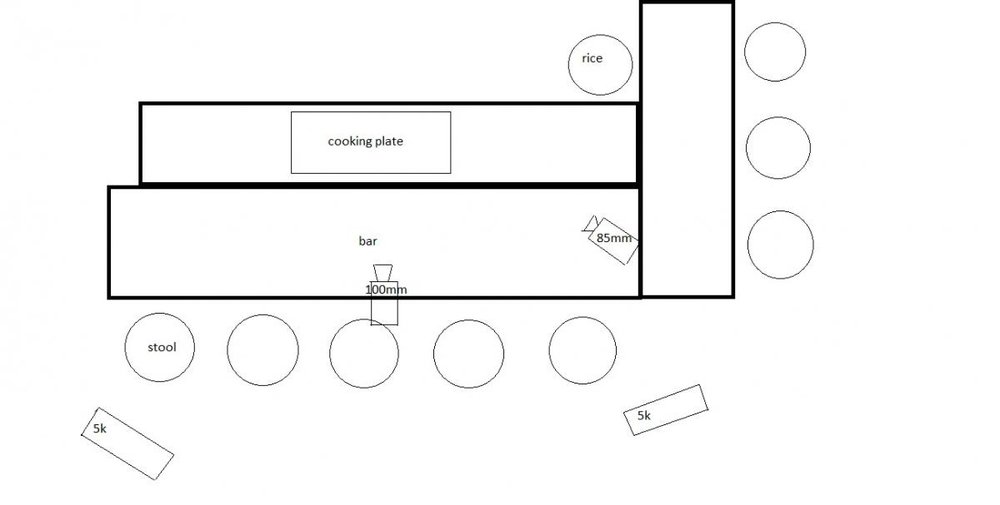
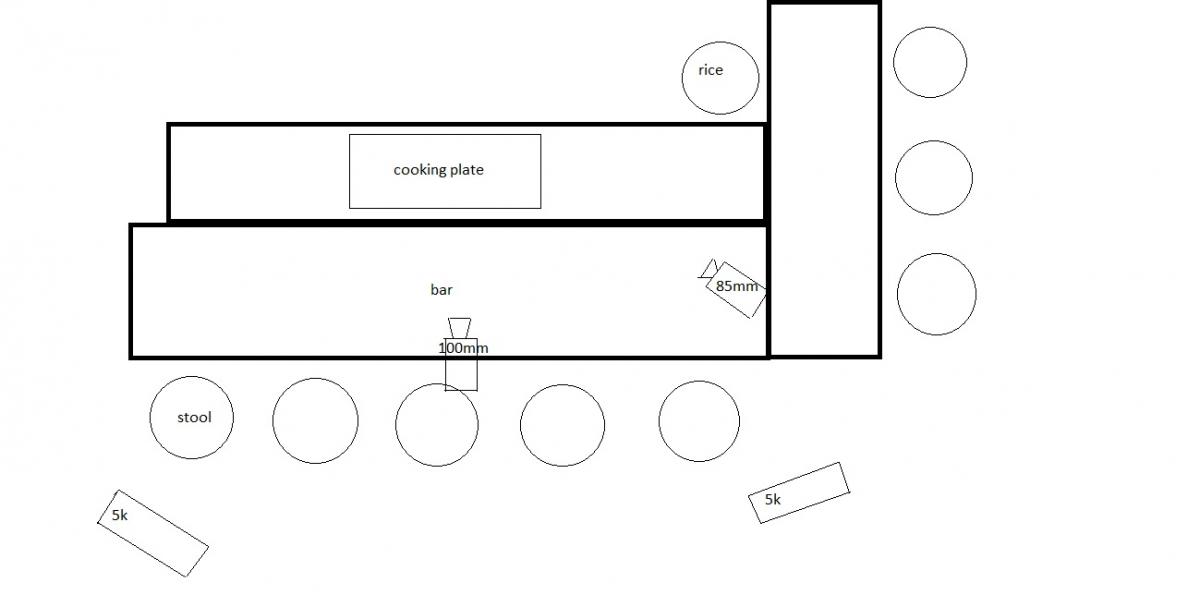
So, I just got a gig where I'm shooting a sushi chef making sushi, and there is mainly focus on showing the food. There will be a lot of close-ups and macro shots. I believe we are going for a high-key type of lighting. There is some ambient lighting from downlights in the ceiling, but it's far from enough. I have access to fresnels and dinos. Would something like what I have sketched down work, or should I go about it another way? Keep in mind the 85mm might be moved from side to side a bit. Thanks!