


Robert Houllahan
-
Posts
2,238 -
Joined
-
Last visited
Posts posted by Robert Houllahan
-
-
3-phase equipment can be fairly easily run with a phase converter and that is mostly the drive motor I would guess.
I would guess that my PhotoMec processor weighs five or more tons so a half ton machine is smaller in terms of film processors.
If you set it up you could likely make it into a reasonable business.
-
 1
1
-
-
19 hours ago, Carl Looper said:
I would conclude from the discussion that the scanstation software doesnt provide for selecting an encoding colour space larger than the Rec.709 triangle. I imagine the sensor would be capable of doing so were it programmed to do so, but given the apparent absence of such an option in scanstation software (based on commentary by those who run scanstations) its a reasonable assumption to make that it only encodes in terms of the Rec.709 colour space.
I do not see any examples or technical data offered or linked to within this thread to make any conclusions from.
Is there any technical examples which form the basis of this assumption? I am not saying it is wrong but some data to draw from would be better than speculation.
-
1
-
-
7 hours ago, Mark Dunn said:
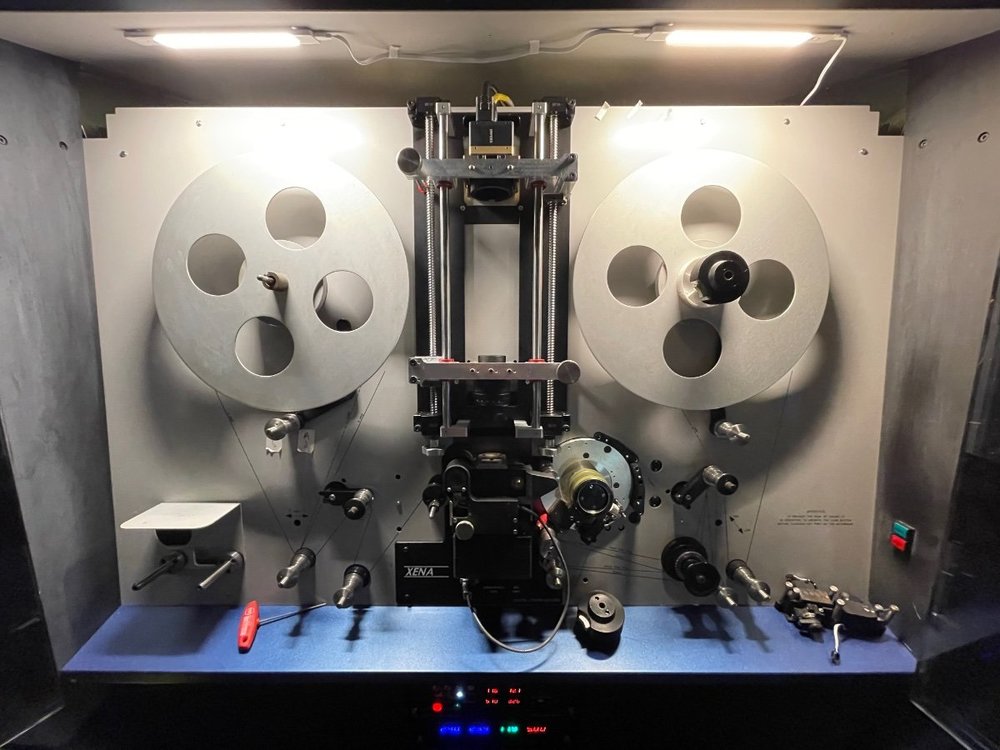
Oh this would definitely be at the long-term homebrew end of the spectrum.
This was once a URSA Y-Front now it is a 6.5K Xena.
-
1
-
 1
1
-
-
If you want modular already fully running kits with mature software for anything from Oxberry scanners to Cintel (and maybe Spirit) Chassis or any level of roll your own to a full turnkey system take a look at the Xena. It is sort of the PC of the scanner world to LaserGraphics Apple as it is allot more technical to setup and run but is now very reliable and males great scans.
www.digitalcinemasystems.net
-
8 hours ago, Adam Dargan said:
Yes, Spectra did the processing, and thenegative.space did an HDR 6K scan with amazing color depth.
Looks great.
New Scan Station scanners do a great job.
-
11 minutes ago, Tyler Purcell said:
Have you tried it yet?
I should do a music video or something, we can muck around with it.
We have run countless feet of Ektachrome in ECN2 the most recent recognizable job was the opener film for this season of NFL Football for NFL Films which was a mix of Color Negative B&W Reversal and 100D Ekta cross processed all with a 3K overscan.
We also had a recent music video project that DP Hutch Crane did with expired VNF run in ECN2 that really did some cool color shift stuff.
Very different look than running in E6.
.
-
On 11/7/2022 at 10:00 AM, Adam Dargan said:
@Tyler Purcell Thank you!
The process you're talking about is the same they did on the show Euphoria right? I would be interested in trying that on a roll sometime to see the difference.Euphoria cross processed the 100D Ektachrome in ECN2 which is a very different look than running it as E6 color reversal.
One of the aspects is that negative stocks like Vision3 have an orange base and the 100D Cross processed has a clear base. And of course you cannot project the Cross Processed film unless you make a print.
-
Processing machines are (mostly) built with off the shelf components like the pumps the heat controls the chain sprockets etc.
The parts which are film specific are the rollers for the film in the tanks and some of the shafts which drive the rollers at the top.
-
I wonder if anyone ever sent a Personal back to get it turned into a full Scan Station?
I think most of the basic components like the chassis are identical, they basically are on the two Scan Station machines I have now except the capstan is on the left on the Personal and on the right on the Archivist which is where the capstan is on most other scanners.
I think LaserGraphics uses allot of off the shelf components for motors and drive stuff to keep costs down and reliability up.
I have not heard of a used Scan Station for sale yet.
-
Looks nice I assume Spectra did the E6 process?
I have run both 35mm and 16mm 100D E6 On our Scan Station in HDR and I think the Scan Station does better with Color Reversal than the Scannity at Spectra does.
-
1
-
-
Saw it is a FilmLab machine, there was a Co in the USA called FilmLine and I had one we ran ECP on, it was huge and old and a bit of a mess. It had a driveshaft and bevel gears for each tank so kind of complex.
Chain drive is pretty simple with sprockets for the drive shafts at each tank and a "demand" roller which governs speed.
-
Congrats!
If you need any tips or help please message me.
Processors have manuals but they are also pretty simple mechanical machines in many ways. Looks like a Film Line processor do you know if it is shaft drive or chain drive?
How many tanks does it have?
-
2 hours ago, Pablo Cruz Villalba said:
I've never used QWD but I've had a similar problem before. I mix my own ecn2. When it happened I figured out that I needed to wash more after the stop bath. Try using a stop bath after developer, wash very well and then proceed. I think those stains happen when bleach meets developer.
In machine ECN2 processing there are air knifes (or squeegees) between each tank to control chemical mixing so for hand processing allot more wash between steps is definitely great advice.
-
7 hours ago, Niels kakelveld said:
The Bauer only goes up to 160 iso unfortunately so anything shot with decent lighting for 500t is going to be horribly exposed. Just for the darkest scenes then. I still need to find an eyecup for it.
I read that the Beaulie 6/7/9008S/pro cameras have a mirror on the shutter instead of a split prism so are the brightest S8 camera's around because you don't loos 1/2-1 stop of light to the splitter.
The Bauer has a manual exposure dial and you can just bypass the auto exposure and keep it wide open.
The Beauleau cameras have an oscillating mirror shutter instead of a beam splitter I believe and thus will get more light to the film for sure.
-
1
-
-
I think the lighting is all over the place color temp wise, I would / have shot allot of similar stuff on both 500t and 250d and I think 500t with superspeed glass is the way to go.
I would recommend a 1 stop push on the 500t even.
-
9 hours ago, Tyler Purcell said:
Beautiful machine, funny how DFT is waking up to this design. Similar idea to the Scan Station actually. Kinda nothing like the older DFT products. Did you by any chance get a price on this?
It is allot more like the Director or Arriscan XT than the Scan Station as it is true RGB and multi flash per color HDR plus IR.
The DFT Oxscan 14K for 67/70 is also a area scan monochrome sensor.
Line scan scanners are probably allot harder to engineer and the line sensors available are far more limited.
I would guess $6-750K for the new DFT machine before options.
-
Well... the problem with a 2-Stop push is slowing the linear film processor down enough to get the timing right in the developer tank(s) we run our Allen (35/16/8) processor at 26FPM for normal process. So a 2-Stop push is about 8FPM which is pretty slow, so we only really offer a 1-Stop push. We can also alter developer temp but because E6 is pretty complex it would be very time intensive to setup for both mechanical and temp to get that.
I agree with rating Ekta down and giving it more light I think the 100D looks nice at 80iso.
-
All of the DFT scanners have very good casters and then screw down feet.
-
2
-
-
-
Do you want to compare an AMG-GT (Arriscan) to a Ford -GT (LG Director) by a decade old image on one of the companies web sites?
Good luck buying your $500K + scanner system.
These are True RGB scanners and in another class of machine than the Scan Station.
I have scanned positives on my Arriscan it can do a good job, not my first choice to do that. I bet the Arriscan XT with it's new ALEV - Alexa sensor would do great.
Remember to always believe all companies marketing claims on their web sites at all times for a healthy life.
-
That will expose well on film I would use a spot meter and try to get the actors skintone in the middle and let the hilites go as film really handles that well.
Don't be afraid of the medium it is very forgiving if you get basic exposure right.
What stock are you shooting on? 500T?
-
I looked at the QWD pdfs and there is a spec for Developer A and Developer B in the MSDS on that but I did not see any mixing instructions, it could very well be a mixing issue causing this.
yeah send me a message come visit the lab.
-
2
-
-
Looking at the QWD kit I see it is all powdered and with Kodak ECN2 the developer is multi part and there are very specific steps to mix it to make the working solution, so I am not sure how QWD works if it is a single pack of powder for the developer.
I see you are in Boston if you want to come to the lab we can probably give you some actual kit mixed ECN2 liquids to try.
-
1 hour ago, Ali Shah said:
HI, I will try agitating with more vigor. I don't think its a silver retention issue- as I went through a second bleach/fix cycle with these negatives and there was no discernible change. I believe this is the process to follow to remediate silver retention. Is that correct?
Yes you can re run through the bleach and fixer to wash more retained silver out. I am pretty sure that works (not something a lab really gets a request for) so I will ask someone I know who is older and wiser to confirm.
Are you processing in something like a Jobo tank? Maybe try flipping the tank over over a few times a minute on the rotator ? Just to shake it up.

Aaton LTR54 with daylight spools
in Camera Assistant / DIT & Gear
Posted · Edited by Robert Houllahan
short
As long as the film is in a bag in the can we don't generally care if it is on a core or not, I ran 1600ft of 16mm ECN from an SR3 today with no cores and EZ to put cores in to prep in the darkroom to develop.
I have shot with 100ft daylight spools on both my LTR and XTR they work but they are very noisy.
No need to inform the lab it is short (we will figure that out) but as Mark said definitely let us lab folks know of you send a 16mm roll in a 35mm can as that will be relevant to scheduling what gauge is run and if it is opened in the dark and found to be 16mm while prepping 35mm it goes back to the beginning.