



Robert Houllahan
-
Posts
2,364 -
Joined
-
Last visited
Everything posted by Robert Houllahan
-
I agree! 4:3 is a waste and in a pinch you could up-res the 16:9 D-beta to DvcProHD or HDCam with a Terranex box. -Rob-
-

"Cloverfield" making some viewers sick.
Robert Houllahan replied to Chris Keth's topic in General Discussion
Sorry , I know this is an international list, yes in the US you can just go buy AK-47's for a few hundred bucks at your local gun shop. I am not making this up, it's true, almost as common as orange juice. -Rob- -
"Cloverfield" making some viewers sick.
Robert Houllahan replied to Chris Keth's topic in General Discussion
Blah blah it's a "concept" or "revolutionary", or whatever, this piece of hvx with cg is trash, I make my living from film and would not pick up a cheap camera to film a 300' monster that was trying to eat me. I would pick up a gun, I own plenty, and try to stay alive. I was hoping this piece of low end trash would bomb on the numbers but considering that every third spot run in the US last week was for this mcnugget movie I guess every dope was suckered in on this one, I have to buy a few AK-47's for a film I am shooting tomorrow maybe I could test them out on the director and producers of Clovernugget before I have the gunsmith convert them to fire blanks. Hula -
In LA try : www.pixelharvest.com or www.metropolis-mps.com -Rob-
-
Machine leader and splicing techniques?
Robert Houllahan replied to James Steven Beverly's topic in Film Stocks & Processing
Machine leader is usually tougher than white leader, a tape splice like one for editing will break and crash the machine, in general stainless steel staples and special tape splices with punch holes in the film such that the splicing tape contacts side to side through the film for strength are the way to go. Also machine leader does not have perfs... -Rob- -
Quick question, what stocks were used for Last king of Scotland? was any 500t used in Super-16? -Rob-
-
The cost of entry into 8mm or 16mm is really about the same, they have different looks, what look are you trying to achieve? You can pickup a cheap Super8 camera or a old B+H or other non reflex spring wound 16mm camera for around $100.00. Super-8 stock and processing is a little cheaper than 16mm. At this rate you could pickup both a cheap 16 and a cheap super8 camera and try both out.... -rob-
-
Colorlab bought a Nova telecine and Pro8 is installing a Millenium, both will do 444 as they are both flying spot (CRT) machines, as with most film scanning oversampling will yield better results (nyquist) this is why a 2K scan made on a machine that scans 4k and down-samples will look better than a scan made on a "straight" 2k scanner.... -Rob-
-
I would try to get a pin registered scan (to DPX files) instead of a telecine transfer for this stuff, every bit of stability will help with compositing elements, there are allot of scanners in LA I would think you could find a good deal on a northlight or something similar... -Rob-
-
I do not think it "edges out" a Spirit or Millenium, etc I was just trying to say that the shadow is a great Super8 telecine and a less than optimal machine (Compared to a Spirit 2K or HD, etc) for 16mm or 35mm. The shadow was sold as a lower cost alternative to a spirit and designated as a video only machine. As far as i understand the shadow will not resolve mare than 1440 pixels and that anything higher is interpolated on output to SDI. All thompson telecine's are line array devices, i.e. there are 4 linear ccd's (one for luma and three for R,G,B ) with the Shadow and Spirit-1 the luma is sampled at full res and each color is sampled at half i.e. if luma is 1920 R,G,B are 960 I have always considered the older Spirit to be a 4:2:2 machine even if it produces 4:4:4 at the output. The new 2K and 4K Spirit is a true 4:4:4 capable machine (and actually the three HD,2K,4K all use the same CCD and optical system with capabilities turned on or off depending on what model you buy) as the Luma and the R,G,B linear arrays are full res (2048 or 4096) and can be sampled as such. All Flying spot telecines are 4:4:4 at the front end (tube and photomultipliers) and all newer ones can produce 4:4:4 at 10bits. I am not sure about full edge to edge on the Shadow for Super-8 I know from operating the Spirit that it cannot capture into the sprocket area in Super-16 and I assume this is the same with Super-8 in fact I do not know of any telecine that can capture into the sprocket area without a heavily modified gate. As stated above you can run a Shadow in data mode to get 444 1920 HD but it cannot resolve that on the front end so some of that performance is "made up" like a HVX "makes up" some of it's resolution or a bayer mask cam "makes up" 444... Your mileage may vary. I have seen some very nice Super-8 from the shadow, to get "real" 444 you would need to scan on a Northlight or a Arriscan (both of which do not offer a Super8 gate) or a machine like a Millenium or Nova... -Rob -
-
Max. length of lab rolls?
Robert Houllahan replied to Satsuki Murashige's topic in Film Stocks & Processing
In general I think 1200' is the max for camera negative assembly and 800' is a nice size for transfer purposes. Sometimes we will assemble alternating 1200' and 800' flats for dailies transfer in order to fit the dailies with keycode onto 64min DvCam's or betaSp...with the most efficiency. When a flat of 16mm gets bigger than 1200' it becomes a bit more difficult to handle and you have the danger of dishing it. With 16mm prints it is not uncommon to get 1600' or 2000' flats for transfer, many educational films are of this size. -Rob- -
What to modified on 400' magazine to use on Super 16 EBM??
Robert Houllahan replied to ericyeong's topic in Bolex
Depends on who modified the camera for Super-16 if it was a thorough, proper, job all rollers and surfaces which contact the emulsion will have been machined to accommodate super-16 dimensions. -Rob- -
What to modified on 400' magazine to use on Super 16 EBM??
Robert Houllahan replied to ericyeong's topic in Bolex
I would say that you have to look at any roller or surface that comes into contact with the extended (Super16) area or the film's emulsion and have those rollers or plates machined to match the super-16 area. Those rollers on the throat probably need to be machined for s16 and then re anodized.. -rob- -
I think it looks pretty good for a DIY setup but compared to a good HD Cintel or Thompson telecine the pic seems flat and the color is very washed out. The flip side of that is a used Spirit-1 is around $500,000.00 but if you have ever used one you can see why...... -Rob-
-
Yes, I believe Technicolor moves this gate around from facility to facility but it can be scheduled, I think their rate starts around $1800/hr so it is a top shelf option. I think the Shadow (which i feel lags in image quality compared to other HD telecine's for 16mm and 35mm) is a near ideal match for Super-8 HD transfers (I think the shadow is 1440X1080 native imagers) such that a transfer from FSFT will be about as good as you can get out of the medium... -Rob-
-
We are not yet equipped for HD transfers, unfortunately. dpx or tiff files can be the same resolution as a mov file, in general dpx files are RGB not YUV (like mov video files) which is better color fidelity so if fsft can do a data transfer to dpx files that would be the best quality. Furthermore you could get a quicktime file and export a series of tiff or dpx files from Final Cut which you could further manipulate in shake, after effects, etc. -Rob-
-
If you get a 24fps progressive transfer you could speed change the 24fps to 18fps with no loss, or ask the fsft or colorlab can run the telecine in data mode which would yield dpx files that you could then set to whatever frame rate you would want. -Rob-
-
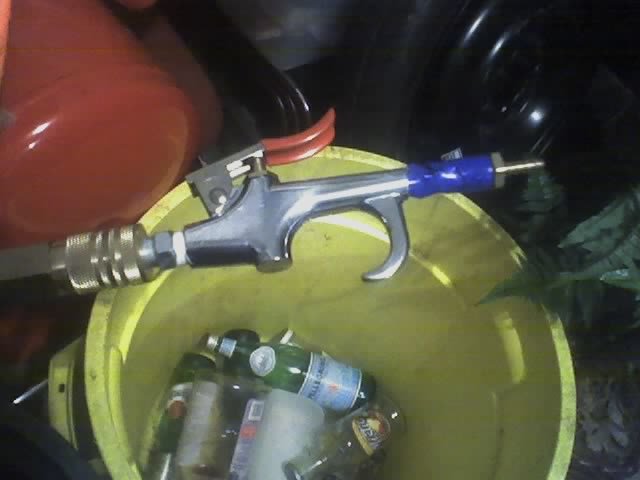
I used a standard small air tank run up to 120psi it had a standard auto shop air hose attached and the 'duster valve" is just a simple attachment to the air hose that has a nozzle and a hand actuated switch valve. These are usually used to blow stuff out and they give good control over the amount of pressure you release. I JB welded a barbed brass end onto the nozzle on the duster valve and attached a 1/4" poly hose to it which I clamped also. The poly hose was run to a rubber which we scored with a razor blade and taped back shut with scotch tape (you don't want tape that is too good scotch tape breaks away easily) we filled the rubber with nasty bloody gunk and taped it to the poly hose (with the hose submerged in the bloody goop) the hose was run up the actors clothing and the rubber was taped to his undershirt and a score was placed in his shirt. I had to put this all together on the fly and did not have time to perfect it, I actually got the idea from some kids who shot a ww2 movie i did some work on. I got 3 shots out of the tank before I had to re pressurize it. All parts were bought at home depot. -Rob-
-
I setup a shot where we had an actor shot back to front with a rifle I used a compressed air canister (small one for filling tires and the like) with a hose and a "duster" valve which was attached to a small poly hose I ran up the actors clothing. We rigged a rubber filled with red gloopy stuff and loosely taped it to the actors chest and placed a cut in his shirt where we wanted the blood to come from. The first take was great because the rubber did not break and there was a big balloon filled with blood and guts on the guys chest. :P The second and third takes came out great with a big blob of blood flying out real horror show... Not perfect but safer than squibs and paintball guns I think it's clothes and position dependent but looks great on film when it works right... -Rob-
-
LCD vs. Plasma TVs
Robert Houllahan replied to Kirsty Stark's topic in On Screen / Reviews & Observations
I know a few engineers at hi end facilities in NY who have been stockpiling crt monitors (D24's and D32's) most of the lcd's which have been evaluated by these guys are not acceptable, including the really expensive "this LCD does everything perfect' ones like the sony's or ecinemas. CRT still rules. I was at a Filmlight show a while back and they had the Baselight hooked up to a nice 50" panasonic 1080p plasma I thought it looked great but I have a plasma at home and prefer the color and contrast to lcd. my .02 -Rob- -
This is really good to know Mike, I am trying to setup a fix for a messy post start on a feature I am shooting, about half of the 300 rolls of Super16 have been transfered to D-Beta in 4:3 letterbox I was not in on this decision but that is film making and it worked at the time. I was wanting to make Flex files from my keylink and have 10bit 16:9 SD files to edit with so a simple timecode in to a quicktime recorder with free run record with LTC and hour 1 at the first "k" frame. Sounds like a intern torture job setting tc for every flat... rob
-
I am one of those people who recommend a "professional" (non DV) format for film matchback keycode reading. It is not because we make more on DvCam or Beta tape but the amount of trouble I have seen with people trying to use DV for matchback cutting. The only professional decks which accept external timecode in (LTC) for MiniDV are JVC's BR-600 and the newer 6000, we have a 600 it is not the most reliable deck and is basically unserviceable "prosumer" IMO all Sony and Panasonic recorders disable timecode in for DV record mode. Most DV equipment will only deal with drop frame timecode for NTSC you can set the JVC deck to non-drop but I have seen various cameras people try to use have problems with non drop timecode. Add to this cross compatibility issues between various cheapo dv gear it just turns messy the tape stock is just a few more bucks and if you want just run DV 63min tapes in Dvcam mode for 40 min each and the cost is the same. -Rob-
-
I believe the Resolve is a modified 2K+ that is Non-Linear grading capable, i.e. it has disk storage and can play multiple streams at once and conform scan files for DI. -Rob-
-
Computers..... I thought about setting up a DPS system the deck emulation with the reality software is really good, I think some Avid's have virtual deck control and of course more hi end solutions like clipster, etc. are great. I am not one who thinks FCP and or the Mac is the only answer, I find FCP clumsy to edit with on a number of levels and the lack of a cheap DDR on the mac is a problem. For sync to FLEX files with LTC coming from a Keylink I think free run recording with LTC timecode will match tape timecode close enough for the purpose. I would hesitate to edit from a disk recording for film matchback and negative cut but it would be fine for building scan reels with handles which need to be conformed and the advantage of uncompressed 10bit files is worth it for a good looking video cut to show.
-
FCP will not take in timecode from the keycode reader, nor can it be controlled like a deck by a TLC so there will be no sync to the flex files, you can do direct capture over SDI as we do in our telecine suites but the timecode is free-run. There are 2 solutions available now to ingest uncompressed sdi with timecode. The first is VVTR with the LTC option at around $2k for software and timecode support, and then uses your G5/MacPro and Decklink card, the second solution is Scopebox with the Horita TCI-50 LTC to 9pin translator box and the G5/MacPro/Decklink combo. VVTR will act as a deck for the TLC and seems to be the most robust solution but is a bit expensive, Scopebox is free run recordings with timecode which may be more of a hack but seems like it would work, I have Scopebox now and we are going to get the Horita box shortly so I can post again after I hook it up to the Telecine and Aaton Keylink keycode reader... -Rob-